The agent eats the stack
For most of my career, using software meant learning where things were. I remember my first few weeks working at Autodesk hunting for which menu, which tab, which of the fourteen tools held the thing I actually needed. We got good at navigating to our destination (the FILLET button), and somewhere along the way we mistook that skill for the work. The last two years have made it clear that "navigation" was never the work. It was a tax we paid because the machine could not yet understand what we wanted.
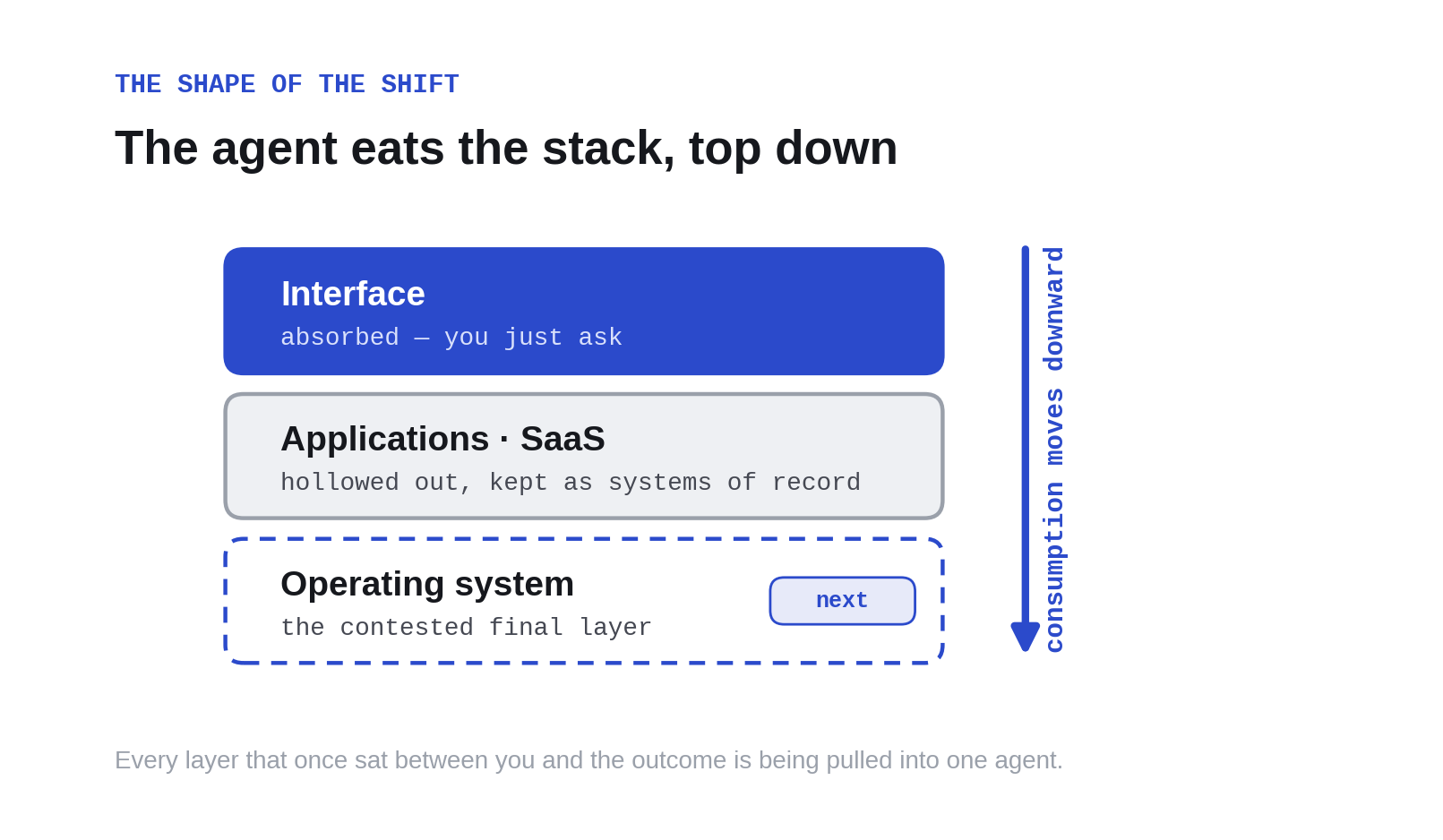
That tax is now being removed. And when you take away the thing everyone organised around, the shape of everything downstream changes with it. I want to lay out where I think this goes across three layers:
- How we interact with software,
- what happens to the SaaS we built our companies on,
- and what ends up sitting at the top of the stack once the dust settles.
The end-game is quite clear to see, and it is the same force seen at three altitudes. The agent is eating the stack from the top down.
Chat becomes the front door, not the whole house
To start off with - A useful distinction we'd need to make is not chat versus interface. It is the kind of interaction we're having.
Some interactions are PULL. You know what you want and you can say it - "Set an alarm". "Plan a trip to Bali in October under a budget". "Send forty dollars to a friend". When intent is clear, language is the most efficient input that exists, because the entire navigation step disappears. You do not open the app, find the screen, and fill the form. You state the outcome and the work happens. This is the category where chat-based experience win outright, and it covers a surprising amount of what we use software for.
Some interactions are PUSH. You do not know what you want, and the whole point is to be surprised. This is discovery, and language is a terrible medium for it. Nobody wants to type a paragraph to be shown two hundred things they did not ask for. This is why Pinterest, YouTube and TikTok are likely here to stay. A rich visual surface that proposes options is doing something a text box cannot, and it will keep its own interface.
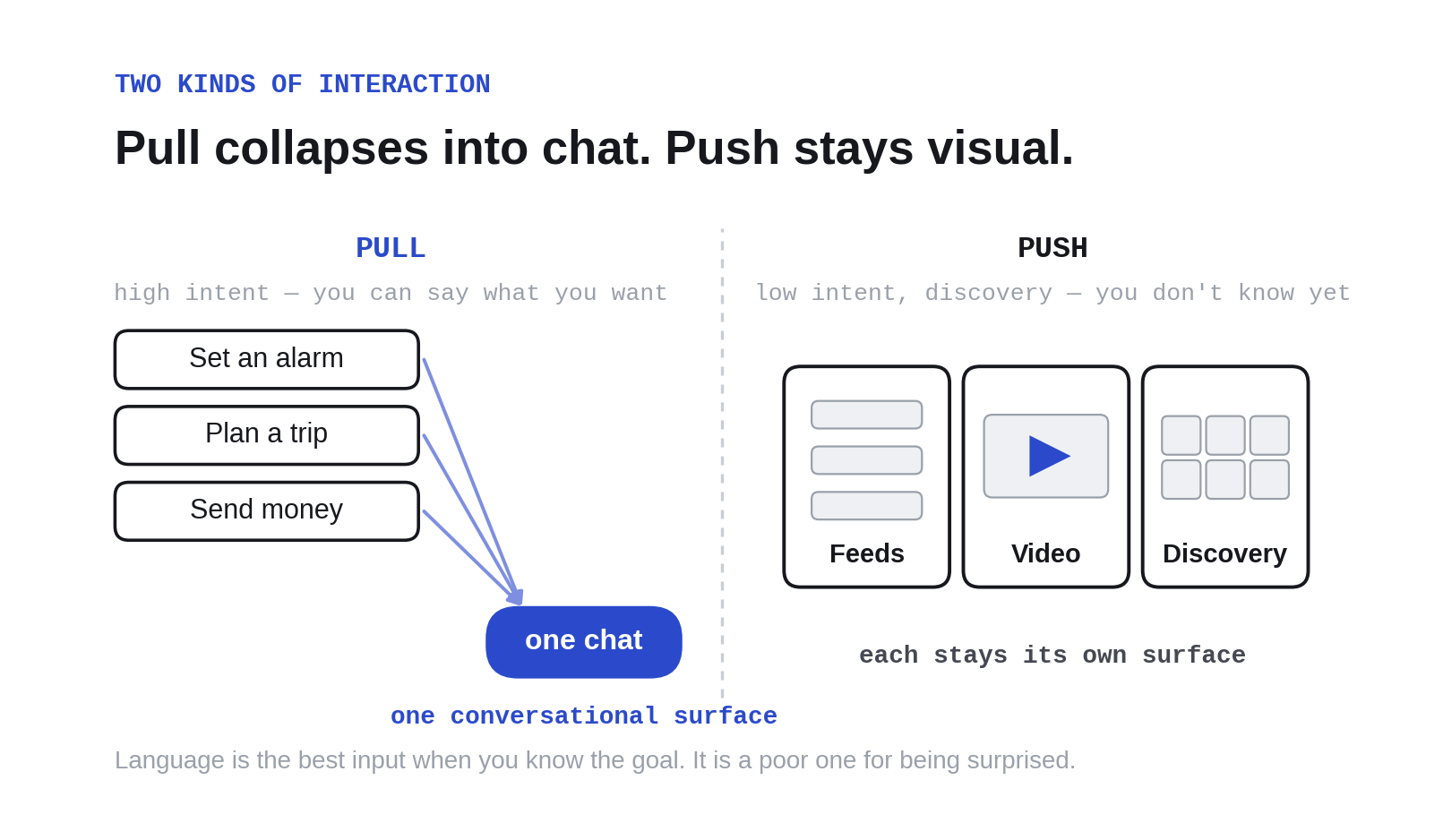
One refinement though - because, the lazy version of this argument is everywhere and it is wrong. Chat does not stay as a wall of text. The mature form is an agent that renders whatever interface the task needs - A map for the trip, a confirmation slider for the transfer, a calendar for the booking. The text box becomes the command line, and the right widget becomes the output. So, this is not chat replacing interfaces. It is "intent-first" replacing "navigation-first". The agent removes the burden of finding things, and then summons the right surface for the moment.
SaaS becomes the system of record
I spent close to decade inside SaaS companies, and I now work on Airwallex infrastructure where every record we write has to be correct across the world. So I do not say the next part lightly. The application layer, as we have known it, is being hollowed out.
I'll start with why the current attempts disappoint. Every incumbent has bolted an assistant onto its product. Gemini inside Google. Rovo inside Atlassian. Copilot inside everything else. They are somewhat functional, and they are also fundamentally limited, for a reason that has nothing to do with model quality.
A bolt-on lives inside a single vendor's data and single vendor's incentives. It cannot cross-reference your JIRA tickets, act on your Slack instance, query your warehouse and book the meeting in a single motion, because no single SaaS vendor will ever build the neutral, "cross-everything" agent that genuinely helps you. Doing so would dissolve the lock-in that is the entire business. The bolt-on is a feature defending a moat - It is not an operating model.
The unbundling mechanism already exists. Through MCP, CLI access and a growing library of skills, an agent can reach into your systems directly. The workflow and the experience lift up out of the application and into the agent. What stays behind is the data: the source of truth, the permissions, the audit trail. SaaS does not vanish. It is pushed down layer to the thing it was always best at being, a system of record.
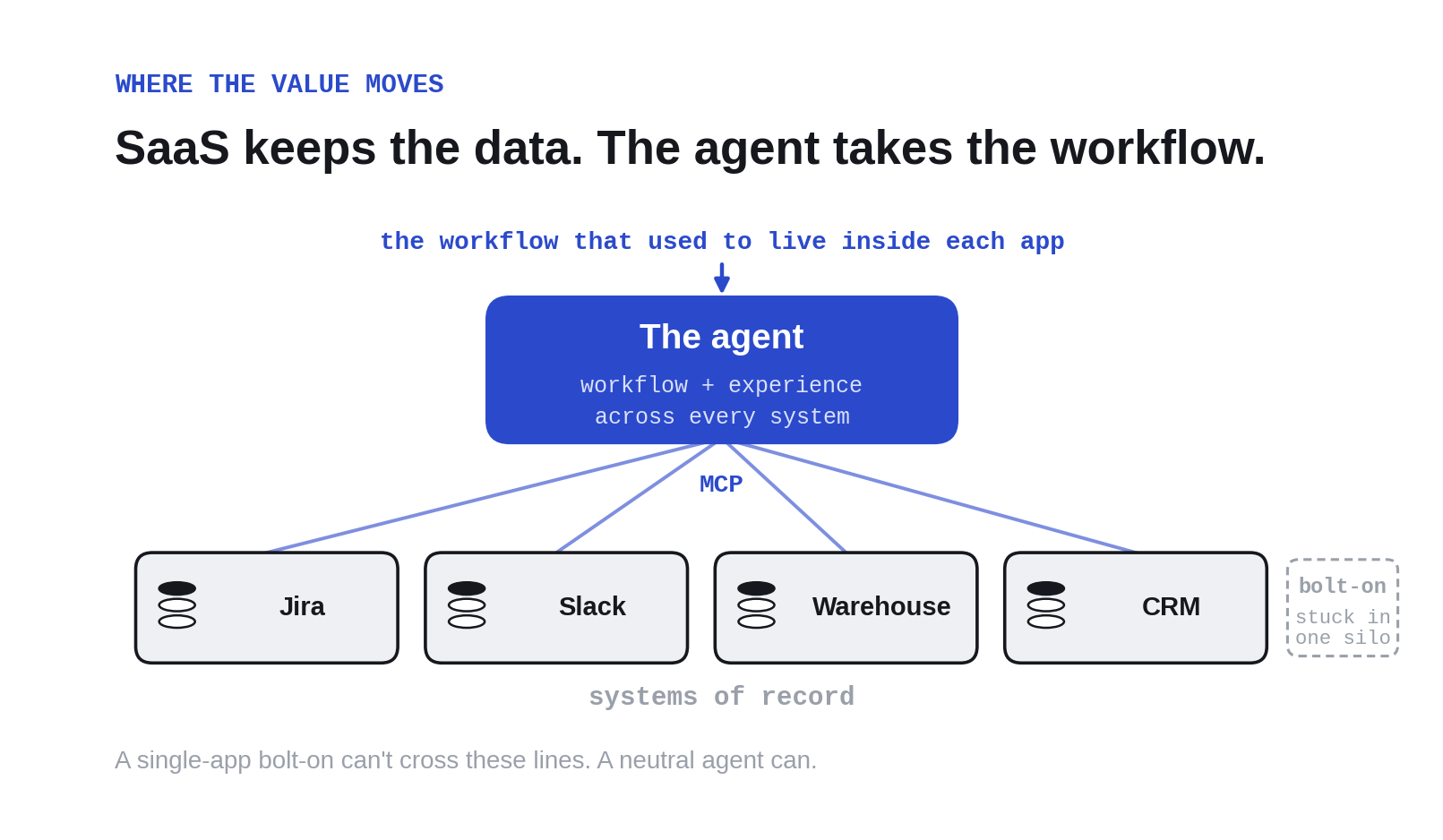
I want to be honest about the limits of my own claim, because the triumphant version of this ("SaaS is dead") is too clean to be true. Data has real, substantive gravity. Permissions, compliance and the proprietary logic of a workflow are real moats, and whoever owns the data can gate, throttle or charge a premium for agentic access to it. The fight does not disappear. It moves to a new front: who controls the agentic access layer to the data. Being the source of truth is still a position of real power.
What detaches from it though, is the experience. And, the experience is where users have always thought the product lived.
At the top of the stack, an "Agentic OS"
Watch where the agent has been allowed to operate, and you can see it climbing.
It started as a bolt-on chat inside a single app. Then it moved into the browser, where something like Perplexity's Comet can act across every site you visit rather than one. Then onto the desktop, where computer use gives an agent the same reach over your machine that you have. Each rung up this ladder buys the agent two things: more of your context, and more ability to actually do something with it. The destination of that climb is not a smarter app. It is the operating system itself.
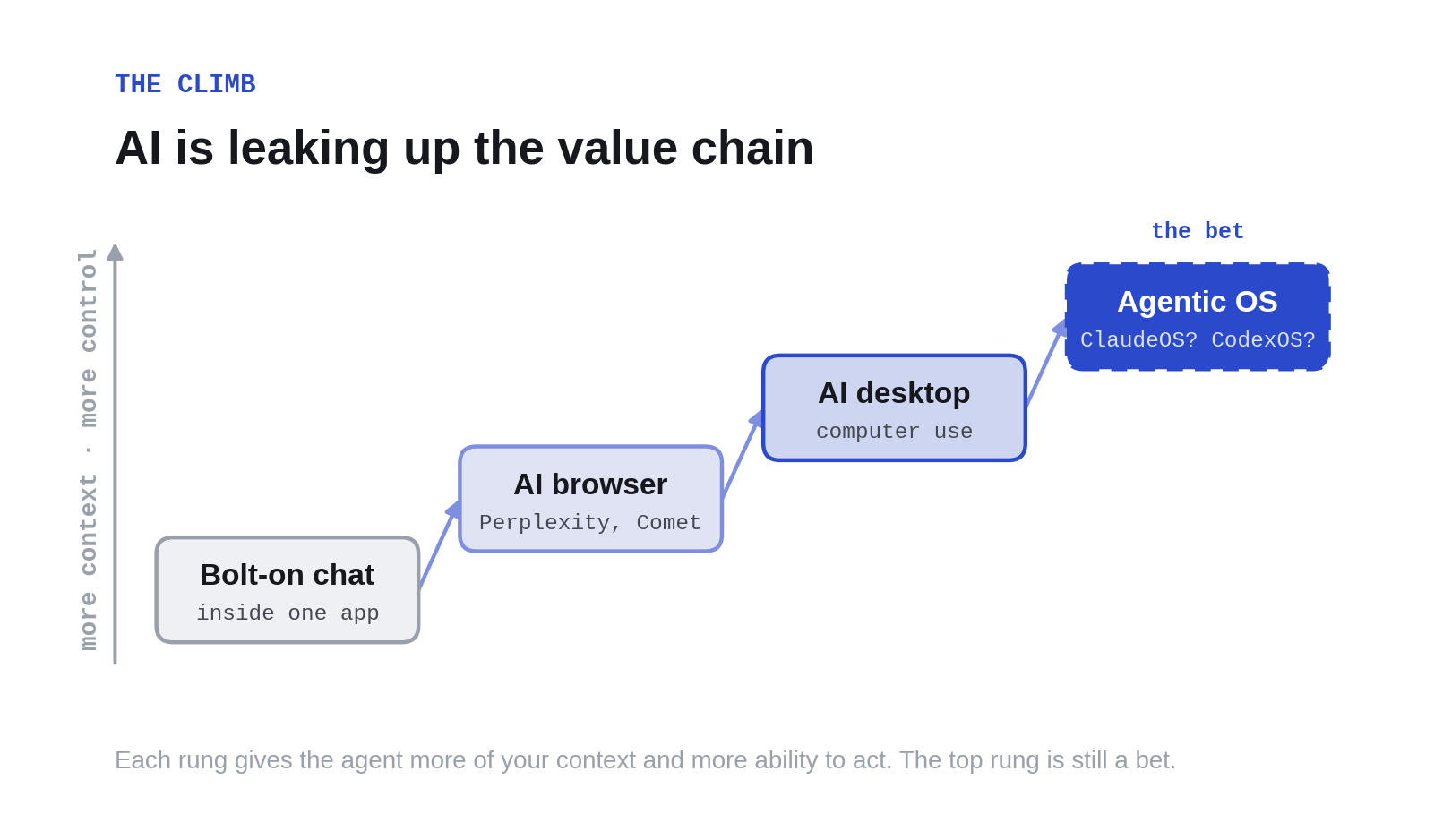
I don't get to access Polymarket in Singapore - If I did, I would absolutely bet on a "ClaudeOS", or a "CodexOS". Operating systems built agent-first from the ground up. It reads as the logical top of the ladder. Picture an environment where you do not launch apps, you live inside the agent, and a third-party ecosystem builds skills and "extensions" the way it once built apps. That ecosystem, not the kernel, is the real prize.
Here is where I would temper the bet. The incumbents own OS distribution, and they are not standing still. Microsoft is folding Copilot into Windows, Apple and Google are agentifying their platforms from the inside. The most likely near-term outcome is not a greenfield winner taking the consumer desktop. It is the operating systems we already use quietly becoming agentic. The greenfield opening is realer in two narrower places. First, in developer and enterprise work, where tools like Claude Code and Codex already function as a de facto operating system for getting things done. Second, in a new device form factor, where there is no incumbent to displace. The honest framing of "agentic OS" is probably not a new kernel. It is a new platform and ecosystem, with the agent as the shell.
Where I am less sure
I hold the direction with high confidence and the timeline with very little. There are a few things that could bend this badly.
- The incumbents may simply absorb the agent layer before a challenger reaches scale, and distribution usually wins.
- The data holders (SaaS) may make agentic access expensive enough that the unbundling stalls at the boundary of the most valuable systems.
- And in the domains I work closest to, anything touching money or regulated data, the bar for letting an agent act autonomously is far higher than a demo suggests, which slows the most useful version of all of this.
None of these reverse the direction. They change how long it takes and who captures the value.
The cleanest summary I have is this. Value is migrating from the application to the agent. The interface collapses first, the application layer follows, and the platform is the contested prize at the end. If you build software, the question quietly changes underneath you. It stops being "what does our app do," and becomes "what can our data and our actions do inside someone else's agent." That is a less comfortable question.
If something here resonates, or if you think I have a piece of it wrong and can show me why, either is worth hearing.
Building things that matter.